
UNIT III: Budding, Grafting & Rejuvenation
Budding and grafting - selection of elite mother plants, methods. Establishment of bud wood bank, stock, scion and inter stock, relationship- Incompatibility. Rejuvenation through top working - Progeny orchard and scion bank.
Table of Contents
Budding and Grafting
Selection of Elite Mother Plants & Methods
1. INTRODUCTION
Budding and grafting are asexual (vegetative) propagation methods used to:
- Maintain true-to-type plants
- Combine desirable traits of two plants:
- Scion/Bud → fruit quality, yield
- Rootstock → vigor, disease resistance, adaptability
👉 Common in fruit crops like mango, citrus, apple, guava, sapota, ber
2. SELECTION OF ELITE MOTHER PLANTS
Elite mother plants = genetically superior, true-to-type, healthy plants used as source of:
• Scion wood (grafting)
• Budwood (budding)
2.1 Criteria for Selection
- Genetic Purity
- Must be true-to-type variety
- No genetic variation
- Selected from authenticated orchards
- High Yielding Ability
- Consistent high yield over years
- Regular bearer (avoid alternate bearing types)
- Superior Fruit Quality
- Size, color, taste, aroma
- High TSS (Total Soluble Solids)
- Good shelf life & market acceptability
- Disease & Pest Free
- Free from:
- Viral diseases (very important)
- Bacterial and fungal infections
- Should be indexed for diseases (certified material)
- Free from:
- Age of Plant
- Should be mature but not senile
- Ideal age: 5–10 years (depending on crop)
- Known Performance Record
- Documented performance under local conditions
- Selected from mother blocks / nucleus stock
- Good Growth Habit
- Vigorous but manageable canopy
- Strong branches suitable for scion collection
- Climatic Adaptation
- Adapted to local agro-climatic conditions
- Ensures better field establishment
2.2 Mother Block Management
Maintained under strict supervision. Regular:
- Pruning
- Fertilization
- Irrigation
- Protection from pests/diseases
- Labeling and record keeping essential
👉 Ensures quality propagation material
3. BUDDING
3.1 Principle
Based on cambial contact between:
- Bud (scion)
- Rootstock
Successful union → callus formation + vascular connection
3.2 Common Methods of Budding
1. T-Budding (Shield Budding)
T-budding is a common, highly efficient plant propagation technique where a single bud (scion) is inserted into a T-shaped cut in the bark of a healthy rootstock, primarily used for fruit trees and roses. It is best performed when the bark is "slipping" (active growth) in spring or summer, requiring a sharp knife and tight wrapping to connect the cambium layers for successful fusion within 2-4 weeks.
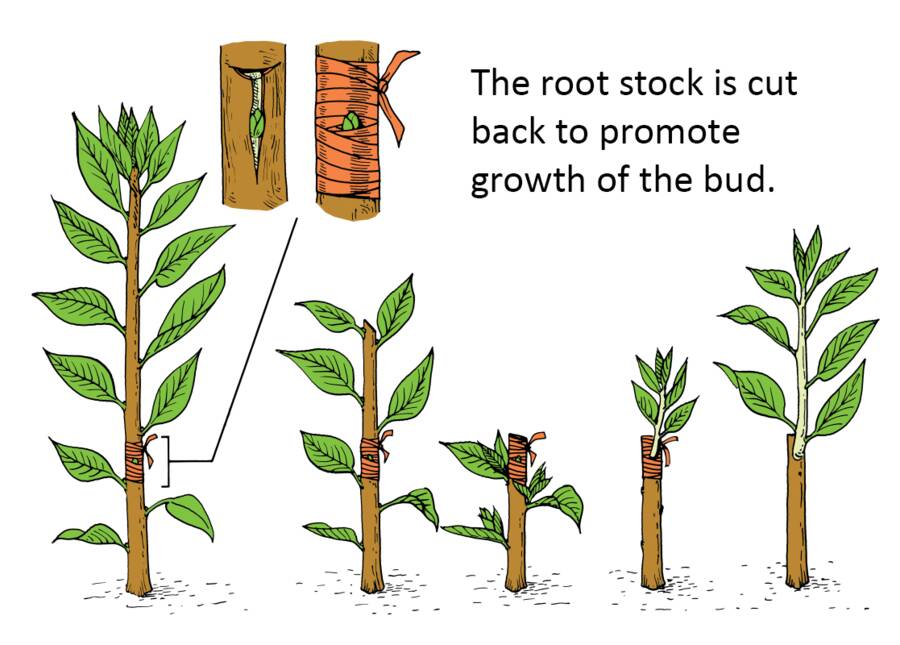
Steps:
- T-shaped cut on rootstock
- Bark flaps opened
- Bud inserted under bark
- Tied with polythene strip
Suitable for: Citrus, rose, peach
Conditions: Bark should slip easily (active growth)
2. Patch Budding
Patch budding is a grafting technique for thick-barked trees (pecans, walnuts, citrus) involving replacing a rectangular bark patch on a rootstock with a matching patch containing a dormant bud from a scion. Performed in spring or summer, it requires tight wrapping of the bud patch to secure cambium contact for successful vascular union.
Steps:
- Rectangular patch removed from rootstock
- Same size bud patch inserted
- Wrapped tightly
Suitable for: Mango, sapota
Advantage: High success rate in thick bark species
3. Ring Budding
Ring budding, or annular budding, is a specialized horticultural propagation technique where a complete ring of bark containing a healthy bud is removed from a scion and fitted onto a similarly prepared, girdled rootstock of the same diameter. It is commonly used for thick-barked trees, such as peaches, plums, and pecans.
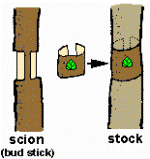
- Complete ring of bark removed and replaced
- Less common due to risk of girdling
4. Chip Budding
Chip budding is a highly successful (90–95% success rate) grafting technique used for fruit and ornamental trees like apples, peaches, and citrus. It involves inserting a bud with a small chip of wood into a matching notch on a rootstock, often done in summer or spring when bark is not necessarily "slipping". It is favored for creating strong, straight trunks.
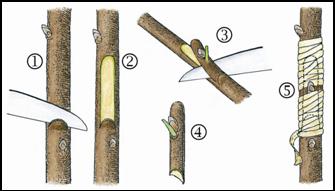
- Bud inserted with small wood chip
- Used when bark is not slipping
3.3 Factors Affecting Success of Budding
- Proper cambial contact
- Moisture availability
- Temperature: 20–30°C ideal
- Active growth stage
- Skill of worker
4. GRAFTING
4.1 Principle
Cambium of scion and stock must align. Callus formation → vascular continuity → union.
4.2 Components
- Scion → desired variety
- Rootstock → root system provider
4.3 Methods of Grafting
1. Whip and Tongue Grafting
Whip and tongue grafting is a highly effective, popular plant propagation technique used to join a scion (cultivated variety) to a rootstock, typically when they are of similar diameter (1/4 to 1/2 inch). By creating interlocking, diagonal cuts that increase surface area for cambium contact, it ensures a strong, secure, and fast-healing union often used for grafting fruit trees like apples and pears.
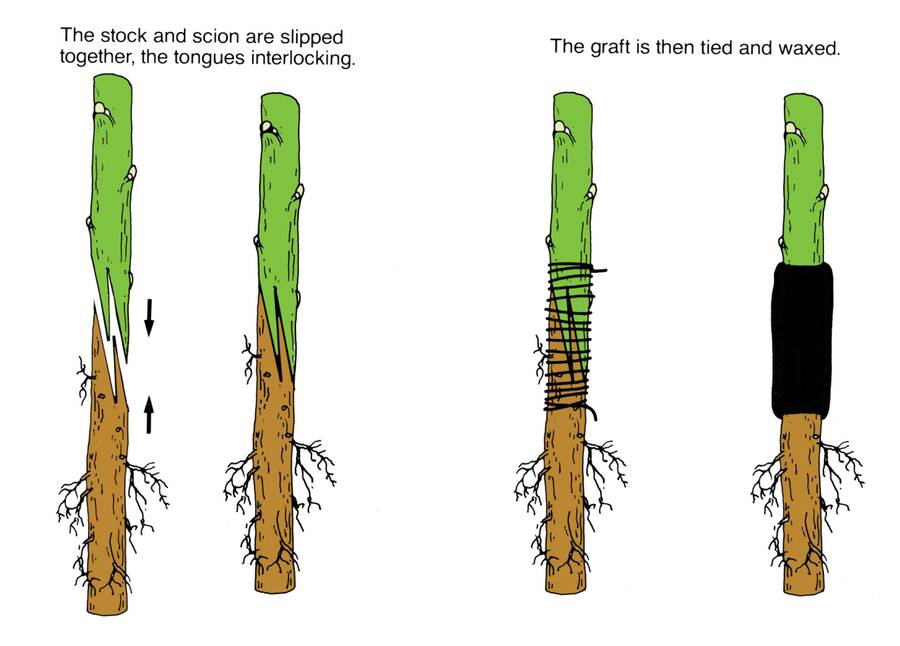
Steps:
- Slant cuts on both stock and scion
- Tongue cut for interlocking
- Tied firmly
Suitable for: Apple, pear
Advantage: Strong union
2. Cleft Grafting
Cleft grafting is a, simple, popular technique used to propagate fruit trees and topwork new cultivars onto existing rootstock. Performed in early spring, this method involves splitting the host stem (rootstock) and inserting one or two wedge-shaped scions, ensuring the cambium layers align for successful union.

Steps:
- Rootstock split vertically
- Scion inserted as wedge
- Tied and sealed
Used for: Top working old trees
3. Veneer Grafting
Veneer grafting is a popular propagation method, especially for mangoes and conifers, involving attaching a scion to the side of a rootstock without decapitating the latter. It is highly effective for joining different-sized materials, using a, "veneer" slice to align cambium layers, resulting in quick healing and high success rates.

Steps:
- Shallow cut on stock
- Matching cut on scion
- Joined and tied
Suitable for: Mango
4. Approach Grafting (Inarching)
Inarching (or approach grafting) is a propagation technique where two independent, self-sustaining plants are grafted together while both remain on their own root systems. Common in mango, guava, and sapota, this technique bridges a scion from a parent tree with a potted rootstock, creating high success rates.
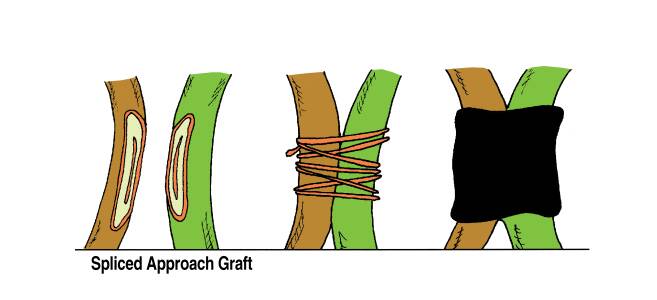
Steps:
- Two independent plants joined
- After union, scion separated from original plant
Used in: Mango (traditional method)
5. Softwood Grafting
Softwood grafting is a highly successful propagation method for tropical fruit trees like mango, cashew, and jackfruit, involving the joining of a fresh scion to a young, tender rootstock. This technique involves selecting 8–10 month old rootstocks and grafting onto their soft, green, succulent top portion using a cleft graft method.

- Done on young, actively growing shoots
- Popular in mango propagation
4.4 Factors Affecting Grafting Success
- Cambial alignment
- Compatibility of stock & scion
- Environmental conditions:
- Temperature: 20–30°C
- High humidity
- Proper tying & sealing
- Disease-free material
5. COMPARISON: BUDDING vs GRAFTING
| Feature | Budding | Grafting |
|---|---|---|
| Material used | Single bud | Shoot (scion stick) |
| Season | Active growth | Dormant/active |
| Skill | Moderate | High |
| Success rate | High | Moderate |
| Example | Citrus | Mango |
Establishment of Bud Wood Bank, Stock, Scion, Interstock & Incompatibility
1. BUD WOOD BANK (BWB)
A bud wood bank is a scientifically maintained plantation of elite mother plants used for continuous supply of:
• Budwood (for budding)
• Scion sticks (for grafting)
👉 Ensures true-to-type, disease-free planting material
1.2 Objectives
- Maintain genetic purity
- Supply certified budwood
- Prevent spread of viral/systemic diseases
- Ensure uniform orchards
1.3 Establishment of Bud Wood Bank
- Site Selection
- Well-drained, fertile soil
- Free from soil-borne diseases
- Isolated from commercial orchards (avoid contamination)
- Selection of Planting Material
- From elite, true-to-type mother plants
- Virus-indexed and disease-free
- Preferably from nucleus or breeder stock
- Planting Layout
- Proper spacing (crop-specific)
- Labeling of each plant (variety, source)
- Management Practices
- Regular pruning → promote new shoots for budwood
- Balanced fertilization
- Irrigation management
- Strict pest & disease control
- Sanitation Measures
- Disinfection of tools (e.g., 70% alcohol)
- Avoid mechanical transmission of viruses
- Rogue out infected plants immediately
- Certification & Record Keeping
- Maintain records: Source of plant, Performance data
- Certification by agencies like: ICAR, National Horticulture Board
1.4 Importance
- Provides uniform nursery plants
- Essential for commercial fruit production
- Reduces orchard variability
2. STOCK, SCION AND INTERSTOCK
2.1 Rootstock (Stock)
Definition: Lower part of grafted plant providing root system
Functions:
- Provides water & nutrient uptake
- Controls: Tree size (dwarfing/vigour), Tolerance to salinity, drought, Disease resistance
Examples:
- Citrus → Rough lemon (vigorous), Trifoliate orange (dwarfing)
- Apple → M9 (dwarf), MM106 (semi-vigorous)
2.2 Scion
Definition: Upper part (shoot/bud) that develops into shoot system
Functions: Determines Fruit quality, Yield, Variety characteristics
Requirements: Mature, healthy shoots, True-to-type, Free from pests/diseases
2.3 Interstock
Definition: A piece inserted between rootstock and scion
👉 Used when direct stock–scion combination is incompatible
2.4 Functions of Interstock
- Overcome graft incompatibility
- Control tree size (dwarfing effect)
- Improve: Fruit quality, Adaptability
Example: Apple: Rootstock → vigorous, Interstock → dwarfing type, Scion → commercial variety
3. STOCK–SCION RELATIONSHIP
3.1 Concept
Interaction between stock and scion affects: Growth, Yield, Quality, Longevity.
3.2 Types of Influence
- Effect of Rootstock on Scion
- Tree vigour (dwarfing or vigorous)
- Bearing habit (early or late)
- Fruit size & quality
- Stress tolerance
- 👉 Example: Dwarf rootstock → early bearing, small tree
- Effect of Scion on Rootstock
- Growth rate of root system
- Metabolic activity
- Hormonal influence
- Physiological Interaction
- Movement of: Water, Nutrients, Hormones (auxins, cytokinins)
- 👉 Proper transport = successful union
4. GRAFT INCOMPATIBILITY
4.2 Types of Incompatibility
1. Localized (Structural) Incompatibility
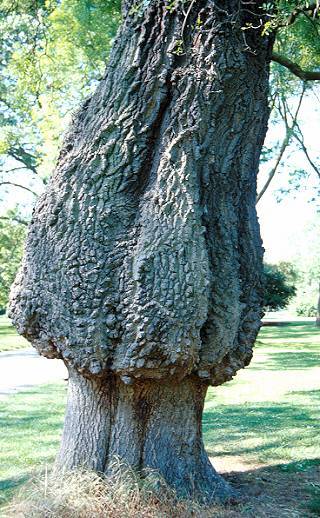
- Occurs at graft union
- Poor cambial connection
- Symptoms: Swelling at union, Weak joint, Breakage
2. Translocated (Delayed) Incompatibility
- Occurs due to biochemical issues
- Symptoms appear later: Yellowing, Poor growth, Sudden death
4.3 Causes of Incompatibility
- Genetic Differences: Different species or genera. Example: distant relatives fail to unite
- Physiological Imbalance: Hormonal imbalance, Poor nutrient transport
- Anatomical Mismatch: Cambium layers not aligned, Poor vascular connection
- Biochemical Factors: Presence of toxic substances, Phenolic compounds accumulation
- Environmental Factors: Temperature stress, Moisture stress
4.4 Symptoms
- Swelling or overgrowth at union
- Cracking or breaking
- Poor growth
- Leaf yellowing
- Early death
4.5 Overcoming Incompatibility
- Use Compatible Combinations: Known tested stock-scion pairs
- Use of Interstock: Acts as bridge between incompatible parts
- Proper Technique: Correct alignment of cambium, Skilled operation
- Healthy Plant Material: Disease-free stock and scion
Rejuvenation through Top Working, Progeny Orchard & Scion Bank
1. REJUVENATION THROUGH TOP WORKING
Top working = Technique of replacing the canopy (shoot system) of an existing tree with a superior variety by grafting/budding on established rootstock or branches.
👉 Used to upgrade old, unproductive or inferior orchards.

1.2 Objectives
- Convert inferior variety → superior variety
- Improve: Yield, Fruit quality
- Reduce time compared to replanting
- Utilize existing root system
1.3 Principle
- Existing tree acts as rootstock
- New variety introduced as scion
- Based on: Cambial union, Callus formation, Rapid canopy replacement
1.4 Suitable Crops
Mango, Citrus, Guava, Ber, Aonla
1.5 Methods of Top Working
- Beheading + Grafting
- Steps: Cut main trunk/branches (beheading) at 1–1.5 m height
- Allow new shoots to emerge, Select healthy shoots
- Perform: Cleft grafting / veneer grafting
- Tie and protect graft
- Frame Working
- Grafting done on primary branches instead of trunk
- Maintains partial canopy
- Side Grafting / Veneer Grafting
- Used on newly emerged shoots
1.6 Steps in Top Working
- Selection of healthy old tree
- Severe pruning/beheading
- Protection of cut surface (fungicide/paste)
- Shoot emergence (after 20–30 days)
- Grafting on selected shoots
- Removal of unwanted shoots
- Training new canopy
1.7 Advantages
- Early bearing (2–3 years vs 6–8 years in new planting)
- Cost-effective
- Maintains established root system
- Rapid varietal replacement
1.8 Limitations
- Requires skilled labour
- Risk of infection at cut surface
- Not suitable for very old/weak trees
2. PROGENY ORCHARD
A progeny orchard is an orchard established using selected superior progenies (offspring) to:
• Evaluate genetic performance
• Identify elite plants for future propagation
2.2 Objectives
- Selection of true-to-type, superior genotypes
- Study: Yield performance, Fruit quality, Stability across years
- Source for: Mother plants, Budwood/scion
2.3 Establishment
- Selection of Parent Plants: High yielding, Disease-free, Superior quality
- Raising Progeny: Through: Seeds (in breeding programs), Vegetative propagation
- Field Layout: Proper spacing, Labeling of each progeny
- Evaluation Parameters: Growth habit, Yield (kg/tree), Fruit size, TSS, acidity, Pest/disease resistance
- Selection Cycle: Multi-year observation (3–5 years minimum), Selection of elite plants
2.4 Importance
- Base for varietal improvement
- Helps in identifying elite mother plants
- Provides material for scion bank/bud wood bank
3. SCION BANK
A scion bank is a maintained collection of elite scion varieties used for:
• Grafting
• Budding
👉 Similar to bud wood bank but specifically focused on scion wood supply
3.2 Objectives
- Ensure availability of: True-to-type scion wood
- Maintain genetic purity
- Supply uniform planting material
3.3 Establishment of Scion Bank
- Selection of Varieties: Superior commercial cultivars, High yield and quality, Disease-free
- Source of Material: From Progeny orchard, Certified mother plants
- Planting & Layout: Proper spacing, Labeling of varieties, Isolation from infected orchards
- Management Practices: Regular pruning → promotes scion shoots, Nutrient management, Irrigation, Pest and disease control
- Sanitation: Tool sterilization, Removal of infected plants, Avoid virus spread
3.4 Characteristics of Good Scion Wood
- Mature but not woody
- Pencil thickness (0.5–1.0 cm approx.)
- 3–4 healthy buds
- Free from pests/diseases
- Collected during dormant or active suitable stage (crop-specific)
3.5 Importance
- Ensures uniform orchards
- Maintains varietal identity
- Essential for large-scale nursery production
4. DIFFERENCE: BUD WOOD BANK vs SCION BANK
| Feature | Bud Wood Bank | Scion Bank |
|---|---|---|
| Material | Buds | Scion sticks |
| Use | Budding | Grafting |
| Structure | Mother plants | Scion source plants |
| Purpose | Bud supply | Shoot supply |
IMPORTANT EXAM POINTS (REVISION)
- Elite mother plants ensure true-to-type propagation
- Cambial contact is the key principle
- T-budding → citrus
- Patch budding → mango
- Veneer grafting → mango
- Whip & tongue → apple
- Environmental conditions crucial for success
- Bud wood bank ensures quality planting material
- Rootstock controls vigour & adaptability
- Scion determines fruit characters
- Interstock helps in compatibility & dwarfing
- Incompatibility → failure of graft union
- Types: Localized, Translocated
- Causes: genetic, anatomical, physiological, biochemical
- Top working = canopy replacement technique (Faster than replanting)
- Progeny orchard → selection & evaluation
- Scion bank → supply of elite scion wood
- All systems ensure: Genetic purity, High-quality planting material
SOURCES
- Hartmann & Kester – Plant Propagation: Principles and Practices
- J.N. Moore & J.R. Ballington – Temperate Fruit Crop Propagation
- ICAR – Handbook of Horticulture
- Chadha, K.L. – Handbook of Horticulture
- Singh, S.P. – Fruit Crops: Production and Management
- NHB Technical Guidelines – National Horticulture Board
- ICAR Nursery Management Manuals
- ICAR Nursery Production Manuals – ICAR